Influencer Marketing Isn’t Reach Anymore - It’s Performance.

Influencer marketing has come a long way, but many brands are still measuring it like it’s 2015, where most briefs still start with:
“How many influencers can we use?”
“How much reach will we get?”
Reach isn’t wrong. But on its own, it’s no longer enough.
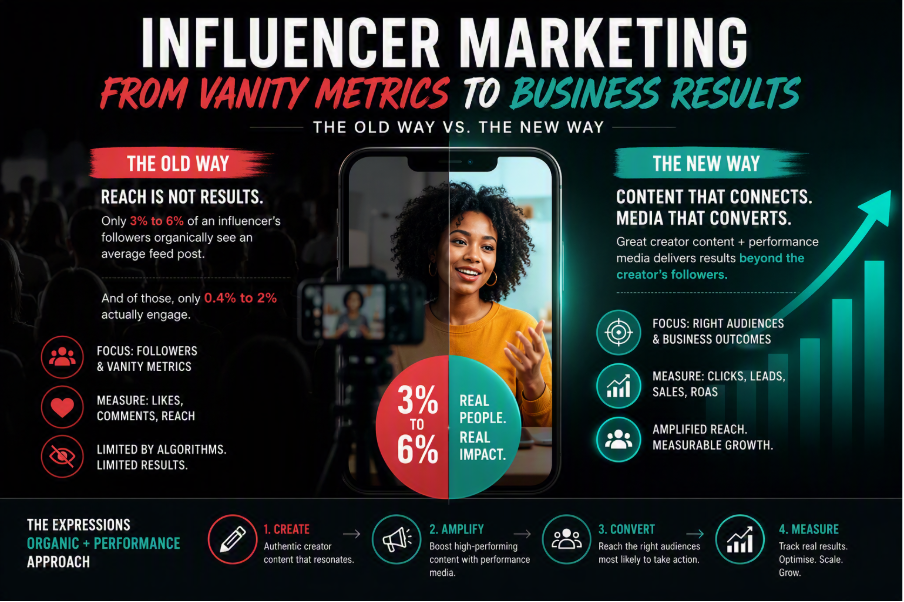
Today, marketing teams are under pressure to show what actually worked — not just what was seen. That’s where influencer marketing needs to evolve from reach-led to performance-led.
The Problem With Chasing Reach
Reach is a comfortable metric. It’s easy to understand, easy to report, and looks good on a slide. But ask yourself this:
Did people click?
Did they search for the brand?
Did they consider buying?
Did anything change after the campaign ran?
In a world of endless scrolling, most content is seen and forgotten within seconds. Being visible doesn’t automatically mean being remembered — or chosen. This is why many brands feel like they’re “doing influencer marketing” but still struggle to prove its impact.
What “Performance” Really Means in Influencer Marketing
Performance doesn’t only mean sales (although that’s often the end goal). It can mean:
Link clicks
App installs
Store visits
Sign-ups
Product views
Branded search uplift
Strong engagement that shows real interest, not passive likes
In simple terms: performance means action.
Influencer marketing works best when it’s designed to move people from: seeing → trusting → acting.
The Shift Marketing Teams Need to Make
1. Stop Choosing Influencers Based on Follower Count Alone
A large following doesn’t automatically mean influence. What matters more:
Who the audience actually is
Whether the creator feels believable for the brand
How their past content has performed
Whether their audience takes action
Smaller creators often outperform bigger ones when it comes to trust and engagement. That’s why the most effective campaigns usually use a mix of nano, micro and macro creators, each playing a different role, with performance then applied.
2. Think Beyond “One Post = One Result”
Influencer marketing shouldn’t be treated as a once-off post and a hope-for-the-best approach. Creators are actually a content engine:
Real people
Real stories
Real usage moments
That content can (and should) be used more strategically — not just posted once and forgotten.
3. Let Paid Media Do the Heavy Lifting
One of the biggest performance unlocks in influencer marketing is simple: Boost what works.
Instead of boosting brand ads, top-performing creator posts can be amplified as paid media — directly from the creator’s handle. This keeps the content authentic while allowing you to:
Target the right audience
Control frequency
Optimise spend
Track results properly
This is where influencer campaigns move from “nice engagement” to real performance.
4. Measure What Actually Matters
If you can’t answer these questions after a campaign, something’s missing:
Which creators performed best?
Which posts drove action?
What should we do more of next time?
What didn’t work — and should be dropped?
Performance-led influencer marketing isn’t about reporting more numbers — it’s about building a learning loop that improves every campaign.
A Simple Performance Influencer Framework
If you’re planning your next campaign, this structure helps keep things focused:
Step 1: Pick One Primary Objective
Choose what success looks like upfront:
Clicks
Conversions
Sales
Store visits
Brand consideration
Step 2: Build the Right Creator Mix
Match creators to the objective — not just the reach target.
Step 3: Brief for Action
Content should guide people toward doing something:
Try this
Click here
Search for this
Visit this store
Step 4: Amplify Top Content
Put paid support behind the best-performing posts.
Step 5: Review, Learn, Improve
Use reporting to:
Be strategic in your review of the campaign, as it unfolds.
Shape the next campaign — not just close the deck.
The Bottom Line
Influencer marketing isn’t just about getting your brand seen anymore.
It’s about:
Being trusted
Being remembered
Driving action
Proving impact

When influencer marketing is treated as a performance channel, it earns its place alongside paid media, content and commerce — not as an experiment, but as a reliable growth lever, which is why Brands are channelling more budget to creators than ATL media in their marketing.
If your influencer campaigns are still being measured mainly on reach, it might be time to rethink the approach — not by doing more, but by doing it smarter, more strategically, and more measurably. Get in touch with us at Expressions Influencer Agency to learn more and to see how we are beating benchmarks with our data-driven organic+performance approach to maximising your R.O.I.
Contact us on info@expressions.agency or send us a contact form from www.expressions.agency
Follow us on LinkedIn: https://www.linkedin.com/company/expressions-agency/


Comments